
More than 4,000 Milton Keynes businesses still don't have a website in 2026
TL;DR
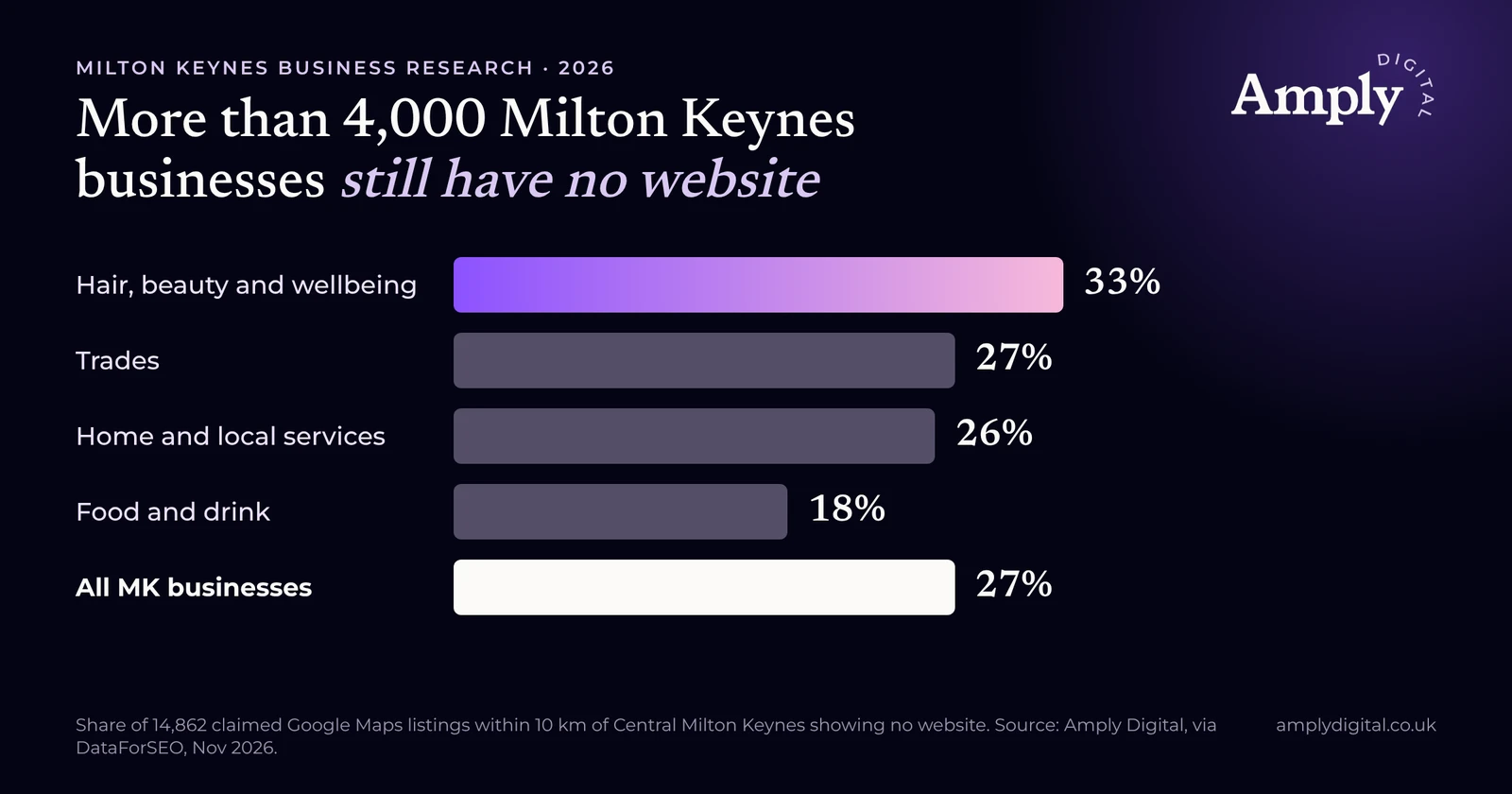
Of 14,862 claimed Google Maps listings across Milton Keynes, 4,055 (27%) show no website, and about 350 more link only to a social media page. Hair and beauty businesses are the most likely to go without, at 33%.
 Written by Nigel Adams
More than 4,000 Milton Keynes businesses that appear on Google Maps have no website of their own, according to new research by Amply Digital, a web design studio in Milton Keynes.
We looked at 14,862 business listings on Google Maps across Milton Keynes that have been claimed by their owners. 4,055 of them, or 27%, list no website at all. A further 350 or so link only to a Facebook, Instagram or Linktree page. Together that’s around 3 in 10 local businesses without a site of their own.
What we found, by sector
Hair, beauty and wellbeing businesses were the most likely to go without. Tradespeople and home services were close to the average, and food and drink businesses were the most likely to have a site.
| Sector | No website | Share |
|---|---|---|
| Hair, beauty and wellbeing | 226 of 689 | 33% |
| Trades | 128 of 471 | 27% |
| Home and local services | 118 of 460 | 26% |
| Food and drink | 123 of 674 | 18% |
| All claimed listings | 4,055 of 14,862 | 27% |
Trades covers plumbers, electricians, builders, roofers and decorators. Home and local services covers cleaners, gardeners, car repair and pet groomers. Food and drink covers restaurants, cafes, takeaways and pubs.
Why it matters
A website is often the first proper impression a customer gets of a business, and it matters at every stage of their decision. When someone first hears about you, they look you up. When they’re comparing you with two or three others, they want to see your work, your prices and what other customers say. And when they’re ready, they want an easy way to book, call or ask for a quote. Without a website, or with one that looks neglected, you can lose people at any of those points without ever knowing they were interested. A good site does the opposite. It builds trust, shows you’re a professional, established business, and turns that interest into enquiries and sales.
Nigel Adams, founder of Amply Digital
For most small businesses, a website is one of the hardest-working sales tools they have. It answers questions at 10pm when you’re not picking up the phone, and it brings in enquiries while you’re busy with customers. It’s also a home you own, rather than relying on a social media platform that can change its rules overnight. A local business website doesn’t need to be complicated. Sometimes, a fast, clear site with five or six pages does the job, as long as it works well on a phone, because that’s where a lot of local searches happen.
Nigel Adams
Websites in an AI world
The gap matters more now that people are starting to use AI tools such as ChatGPT and Google’s AI Overviews to find local businesses. These tools build their answers from what they can read about a business online, and a website is usually the clearest source they have.
People are starting to ask AI for recommendations the way they’d ask a friend. Those tools can only recommend a business they can find and understand. A clear website that spells out your services, prices, areas and reviews gives them something to work with. A Google listing or a social page on its own gives them very little.
Nigel Adams
Three questions before you get a website
- What do customers ask you most? Prices, areas covered, opening times and how to book are the pages that matter first.
- Can you update it yourself? If you’ll want to change prices or add photos, make sure the site lets you, or that someone will do it for you.
- Does it load fast on a phone? A slow site loses people before they’ve seen anything.
If you’d like to know what a website costs, our prices are published.
How we did it
We analysed Google Maps business listings within 10 km of Central Milton Keynes on 27 November 2026, using data from DataForSEO. Only listings claimed by the business owner were included, which leaves out parks, landmarks and unclaimed duplicates. A listing counted as having no website if no website address was shown on it. Sector figures use Google’s own business categories and cover a sample of each sector, not every business in it.
It counts Google listings, not every registered company, so businesses with no Google listing at all aren’t included. Some listings are chains or branches that use a head office site, and a few are for businesses that have since closed. If you’re a journalist and would like the full figures, email hello@amplydigital.co.uk.
Keep reading
All articles
Do I actually need a website?
Written by Nigel Adams
How long does it take to build a website?
 Written by Josh

How much does a website cost in the UK?
Written by Nigel Adams
How to speed up a slow WordPress site
 Written by Nathan

Shopify vs WooCommerce: which should you actually use?
 Written by Jake

Squarespace vs WordPress: which is right for a small business?
Written by Nigel Adams
What WCAG 2.2 AA actually means for your website
 Written by Evie

Wix vs WordPress: an honest comparison
Written by Nathan
WordPress vs Shopify: which for selling online?
Written by Jake
SEO for small businesses: a plain-English starter guide
Written by Nigel Adams
WordPress or headless: how to pick without regretting it later
Written by Nigel Adams
Nine things to fix before you pay anyone for a redesign
Written by Nigel Adams